Leadership Structures
- Defined responsibilities, governance mechanisms, and escalation routes
- A coherent decision logic for both operational and strategic leadership
- Role frameworks that embed accountability at every level
Our work centers on explicit accountability, resilient decision frameworks, and KPI architectures that give leaders a precise and unambiguous operational view.
The PDCA cycle forms our leadership methodology: strategies and processes are designed, executed, evaluated, and refined in a continuous loop — far beyond static documentation.
This creates an organization capable of self-direction and sustained learning.

Executive Advisory: Leadership Enabled by Structure. We work with you to design models that empower leadership — far beyond day-to-day operations.
Effective leadership depends on clarity. Organizations call us when:
Our goal: establish C-level certainty in decision-making – fact-based, consistent, and frictionless.
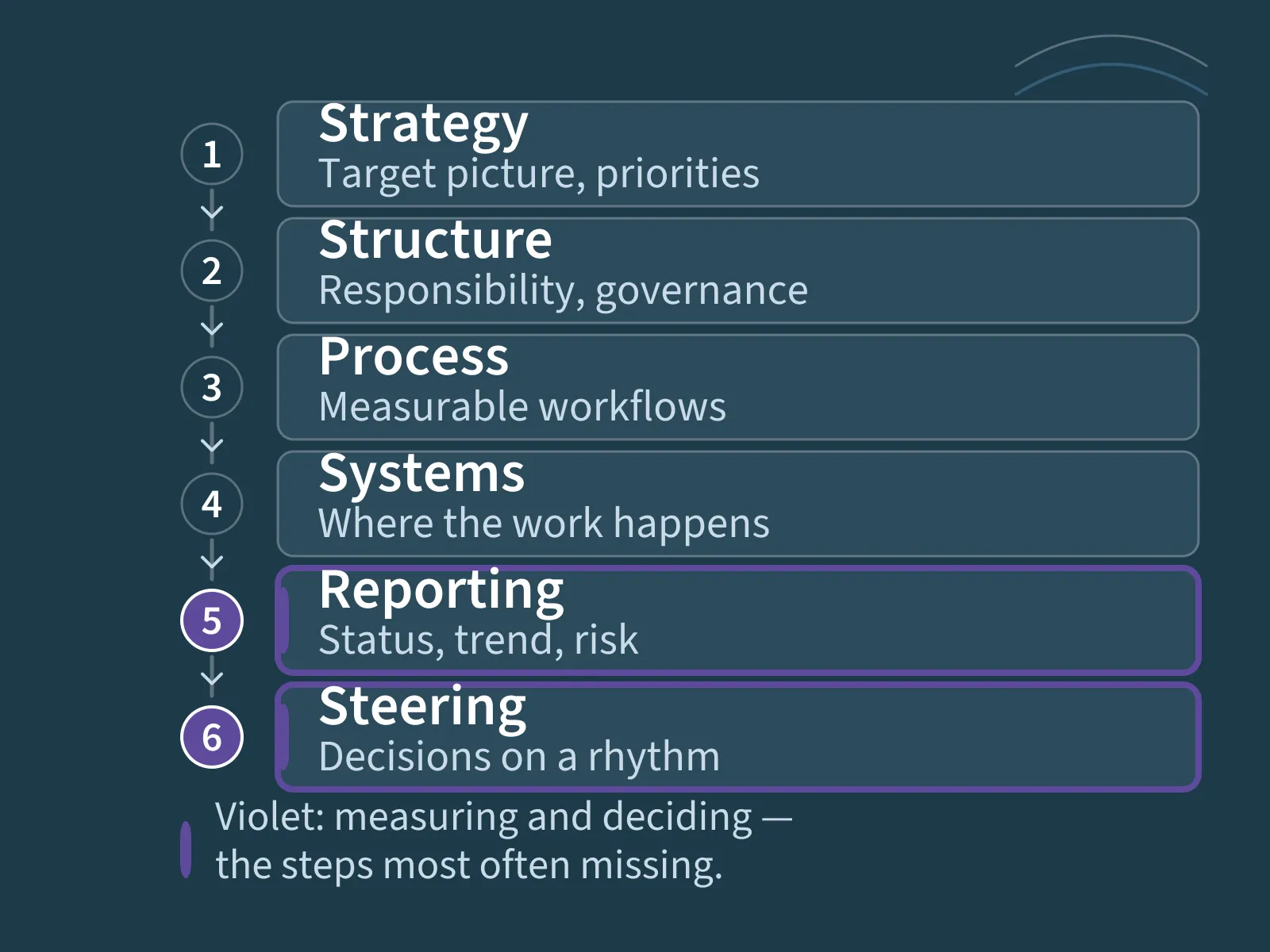
PDCA here is not quality-management vocabulary but the rhythm in which a company is led: planned, done, measured, adjusted. The decisive part is the second half — without measurement, steering stays an opinion, and without consequence, the measurement stays without effect. Why this method is more than a model for Arkcanis is described in the profile of Oliver Groht; the article The Deming Cycle covers it in full.
Target picture, governance logic, metrics, organisational setup, responsibilities. For each metric it is recorded what it measures, what it is built from and who supplies it.
Implementation in systems, tools, roles and processes — where the work happens anyway, rather than in a separate environment built only for steering.
Regular reviews on the same figures: plan against actual, risks, variances. The meeting is in the calendar before the first figure is delivered — otherwise it does not happen.
A variance turns into a decision: priority, restructuring, automation, scaling. Or the insight that the metric was the wrong one — that is a result too.
We develop decision models and reports that give management and owners a consistent picture based on jointly defined metrics:
Our work creates transparency, comparability, and control – structured and without gaps in interpretation.
What such owner reporting looks like down to the individual cost item is shown by the Aviation Control Stack; the basis for it is built in financial reporting.

We unify executive-level advisory with the ability to translate processes and tools into tangible execution — across structure, technology, and data.
A business model can only be managed as well as its data and processes allow.
Leadership becomes easier, faster, and more precise:
The organization becomes measurable, manageable – and therefore more financially stable.

An engagement starts with a conversation about what prompted it and a review of the current state: existing structure, reporting lines, the metrics decisions are based on today, and the points where decisions get stuck. For that we talk to the executive team, department leads and the people who produce the numbers.
You receive a target model with responsibilities, a KPI structure with a definition and a source for each metric, and a review rhythm that fits how you already lead. We accompany the first cycles so the rhythm holds before we step back.
You lead. We advise, structure and accompany implementation. Not included: operational management responsibility, interim management with authority to issue instructions, and legal or tax advice.
Tell us briefly what it is about – we will get back to you.