Flight operations
Your flight operations system provides flights, legs, requests and invoices. That data is the starting point — and it carries the identifier that holds everything else together.
A flight operation's total costs sit in its accounting. What a single flight cost, and what it earned, stays an estimate for as long as operations and accounting are run separately.
The Arkcanis Aviation Control Stack closes that gap. It connects your flight data to your accounting, assigns accounting entries to the flights they belong to — distributing them traceably where one invoice covers several flights — and brings the result into reporting that leadership, owners and controlling can rely on.

Every flight carries a unique identifier in Leon, the NID. It becomes the key: we introduce it into accounting so that entries can be assigned to the flights they belong to.
That key does not appear by itself. Carrying it through is the actual work — it calls for rules on how entries are made, and a decision for every case that cannot be assigned cleanly.
This changes the nature of the answer. An allocation across averages gives way to an assignment that can be traced back to the individual document:
That is where the figures come from: cost per flight, cost per hour and the contribution margin by flight, aircraft and period.
One key. One truth. Full control.
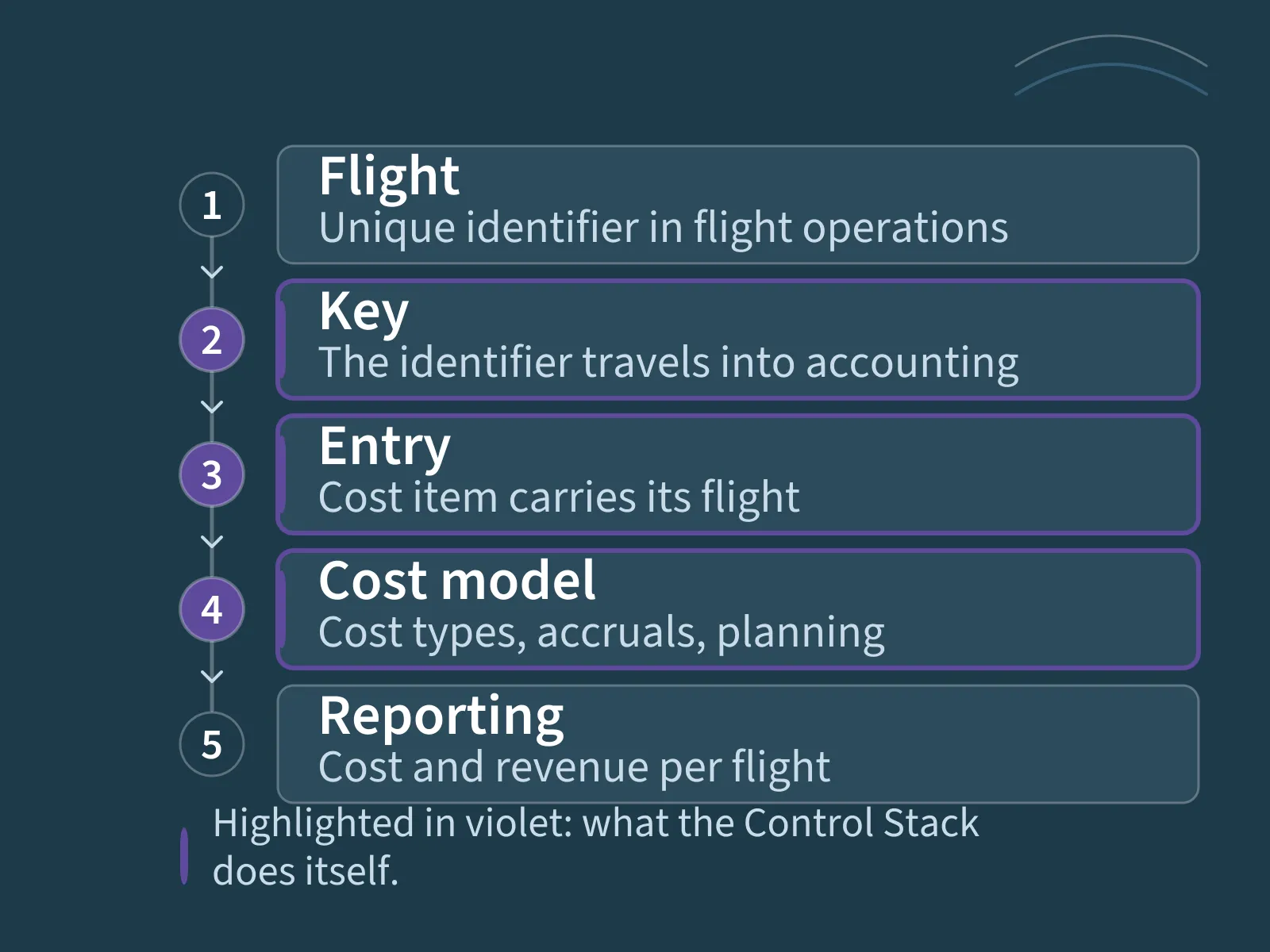
Your flight operations system provides flights, legs, requests and invoices. That data is the starting point — and it carries the identifier that holds everything else together.
Requests, quotes and operational steps run as traceable cases in Jira; the processes behind them live in Confluence. Who decided what, and when, is on the record.
Flight data is moved into a database and prepared so that amounts are assigned to individual legs. That is the basis everything is calculated on.
Accounting supplies the costs. A consolidation and planning tool — in practice LucaNet — turns them into complete cost types, accruals and a reliable plan.
The shared data model feeds the views: for leadership, owners, controlling and sales. Whether they are built in Power BI or Grafana is your call — the substance is in the model, not the tool.
Which of these components apply to you depends on your operation. Behind them stand the individual offerings: the Leon ↔ Jira integration, Leon2DB, Grafana dashboards and data pipelines and ETL. Where sales processes are part of the picture, Jira automation and the Prospect Scout can be connected.
The path is cut into phases that each deliver a result of their own. You do not wait for a complete programme before you see anything.
Cost per flight on your leadership dashboard. A tangible result from the start, and the benchmark for everything that follows.
All cost types captured, exceptions handled systematically, data quality secured. The first figure becomes a complete picture.
Tailored reporting for owners, investors, controlling and sales. Each role sees what it needs for its decisions.
Processes documented, standards established. The transparency stays, even when people change.
Architecture, implementation and operation sit under one responsibility. You do not run several service providers side by side, and you do not have to work out who answers for a result — that question is settled before it arises.
Work is billed as a defined service for an agreed scope, not against open day rates. Your budget is fixed from the outset.
Arkcanis takes overall responsibility for architecture, implementation and the agreed scope of operation. Introducing the consolidation software is part of that undertaking and is covered by the same responsibility.
The stack is not a one-off build: its components are maintained and developed as products.
We do not name our customers unless we have their permission. We handle that the same way for every customer — including you. We are happy to walk you through the process in person.
We start by taking stock: which flight operations system and which accounting you run, how your cost types are structured, and which metrics your decision-makers need. That requires access to the systems involved and contacts from both operations and finance.
From there we derive the cut of the first phase, the connections required and the definition of the metrics. Acceptance includes a reconciliation against your own figures — a metric your controlling cannot reproduce is not a metric.
Setup, adjustments and ongoing services are listed separately in the proposal. Any licences you need beyond that — flight operations system, Jira, consolidation software — we state openly; they sit with you.
The Aviation Control Stack is one expression of a more general pattern. It has four parts: a key that connects the operational side to the commercial one; a cost source that is complete and properly accrued; a data model where the two meet; and views that serve each role.
What the flight is in aviation is the job, the machine hour, the project or the site elsewhere. The question is the same everywhere: what did this one case cost, what did it earn, and can the answer be substantiated?
Whether the pattern transfers to your operation depends on whether a workable key exists and whether your cost side can carry it. We establish that in conversation, before anything gets built.
Tell us briefly what it is about – we will get back to you.