Capture enquiries in Jira
Information from web forms is automatically transferred into Jira issues. Mapping to the required fields is defined, while duplicate prevention reduces repeated issue creation.
When enquiries, supporting information and documentation are handled separately, manual handovers follow. Data is entered again, mapped inconsistently or made available too late for the next step.
The Arkcanis Automation Engine for Jira connects these activities with your Jira workflows. For your implementation, we define which data is captured, which rules apply and which outputs are provided.

A web form alone does not establish a structured sales process. Its information needs to reach Jira, map to the appropriate fields and become usable for subsequent work.
Recurring tasks include:
The engine performs these steps according to the agreed rules.
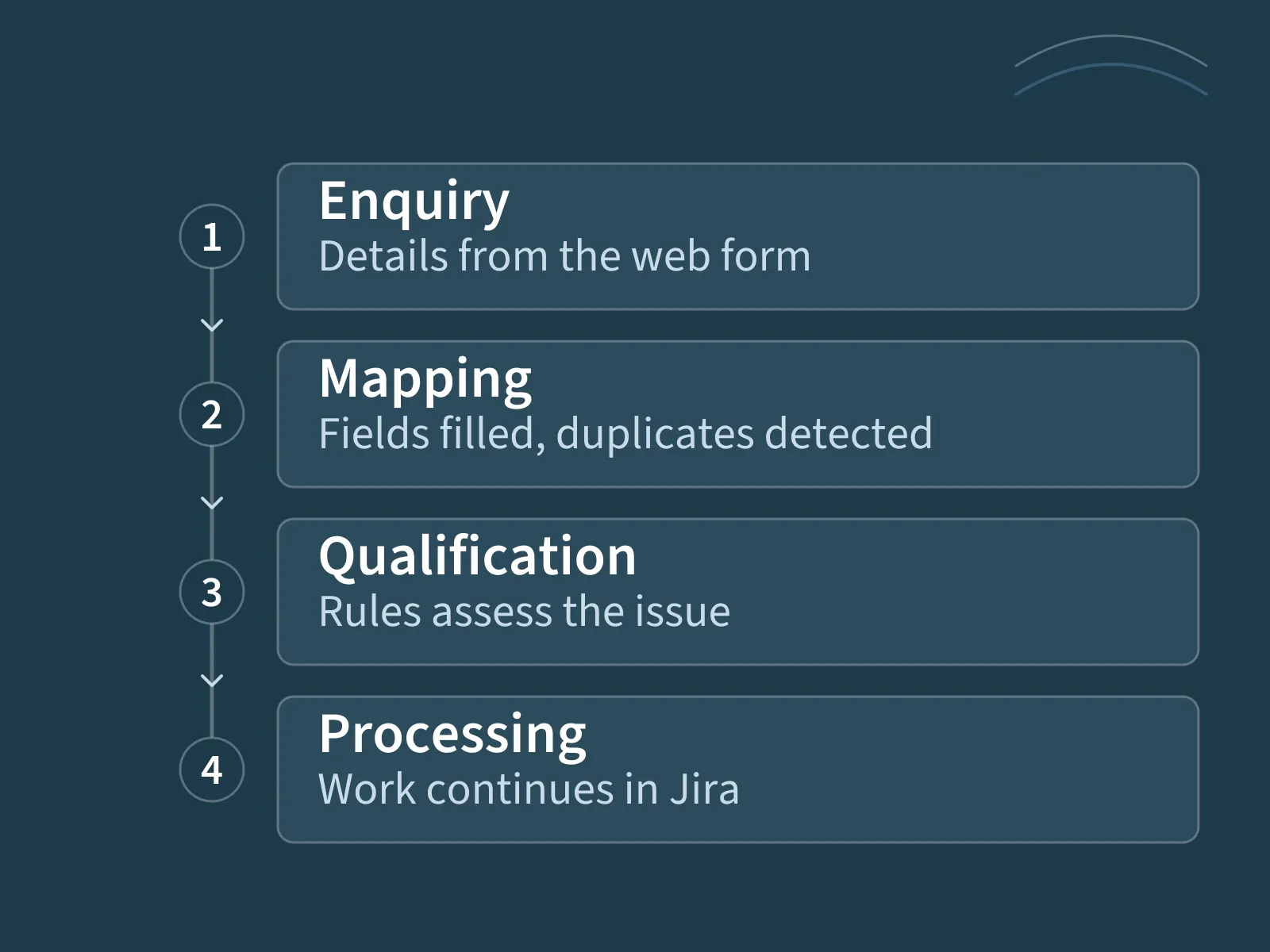
Information from web forms is automatically transferred into Jira issues. Mapping to the required fields is defined, while duplicate prevention reduces repeated issue creation.
Defined triggers start qualification. Rules assess completeness, duplicates and readiness; anything that fails stays visible rather than disappearing, and borderline cases are put to your team.
The engine can use AI to enrich information from multiple sources. Guardrails define which sources are queried and which results may be accepted unchecked — everything else goes to your team for confirmation rather than landing silently in the issue.
Jira data is used to generate static documentation for publication in Confluence. A management system handbook is one possible application. Reviewing and maintaining the content remains part of your process.
Enquiries reach Jira in a structured form. Recurring transfers are automated, allowing your team to focus on the work that requires their expertise.
Field mapping, triggers and documentation follow defined rules. This makes the handover of information between workflow steps clearer.
Several areas or companies can be run separately, each with its own configuration, access and data. The engine appears under your name, not ours.
The engine is maintained and developed as a product, not as a one-off adaptation.
We do not name our clients unless we have their permission to do so. We handle every client that way — including you. We are happy to walk you through the workflow in a conversation.
These technical measures form part of the implementation; your operational requirements are assessed for the specific use case.
The engine works with Jira Cloud; it is not designed for Jira Data Center. We start by reviewing your Jira environment, Confluence where relevant, the data sources involved and the intended workflow. This establishes the required connections, field mappings and processing rules.
The use of AI is also defined explicitly: which information may be processed, which outputs require professional review and which services may be involved?
Setup, adaptations and ongoing services are identified in the proposal. The scope depends on your workflow and the agreed operating model.
When company records first need to be researched and reviewed, Arkcanis Prospect Scout can support this preceding stage.
Scout helps teams discover companies and work through their records. Qualified prospects are then passed into the sales workflow supported by the Automation Engine.
Tell us briefly what it is about – we will get back to you.